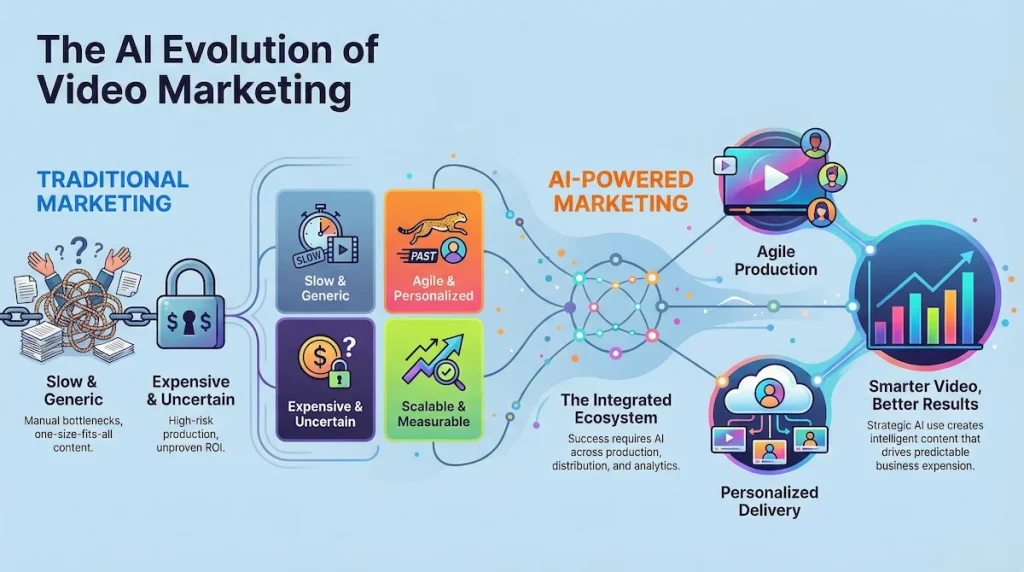
Video marketing is no longer just a creative discipline it’s becoming a technology-driven competitive battlefield. Artificial intelligence is fundamentally reshaping how videos are created, personalized, distributed, and optimized. The question is: Is your video marketing strategy still stuck in the past, or are you ready to harness the power of AI to outpace the competition?
For many marketing teams and business owners, traditional video production remains expensive, slow, and resource-heavy. Concept development takes weeks. Filming requires crews and equipment. Editing demands specialized skills. Then comes the real challenge personalizing content for different audience segments, platforms, and buyer stages.
The result?
- Generic videos that fail to resonate
- Limited personalization at scale
- Campaigns that struggle to deliver measurable ROI
- Missed engagement opportunities while competitors move faster
This isn’t just an efficiency issue it’s a growth bottleneck. In a digital ecosystem where attention spans are shrinking and content volume is exploding, businesses that can’t produce relevant, data-driven video at scale risk being left behind.
Artificial intelligence changes that equation.
AI-powered tools now enable marketing teams to:
- Generate video scripts and storyboards in minutes
- Create professional-quality videos without large production budgets
- Personalize video messaging dynamically for different audience segments
- Optimize performance using predictive analytics
- Repurpose content across platforms with minimal manual effort
In short, AI transforms video marketing from a costly creative process into a scalable, performance-driven growth engine.
This comprehensive guide will demystify AI in video marketing and show you exactly how to implement it strategically. You’ll discover practical use cases, essential tools, and step-by-step strategies that help you reduce production costs, improve engagement, personalize at scale, and drive measurable business growth.
If you’re looking for theory, this isn’t it.
If you’re looking for competitive advantage you’re in the right place.
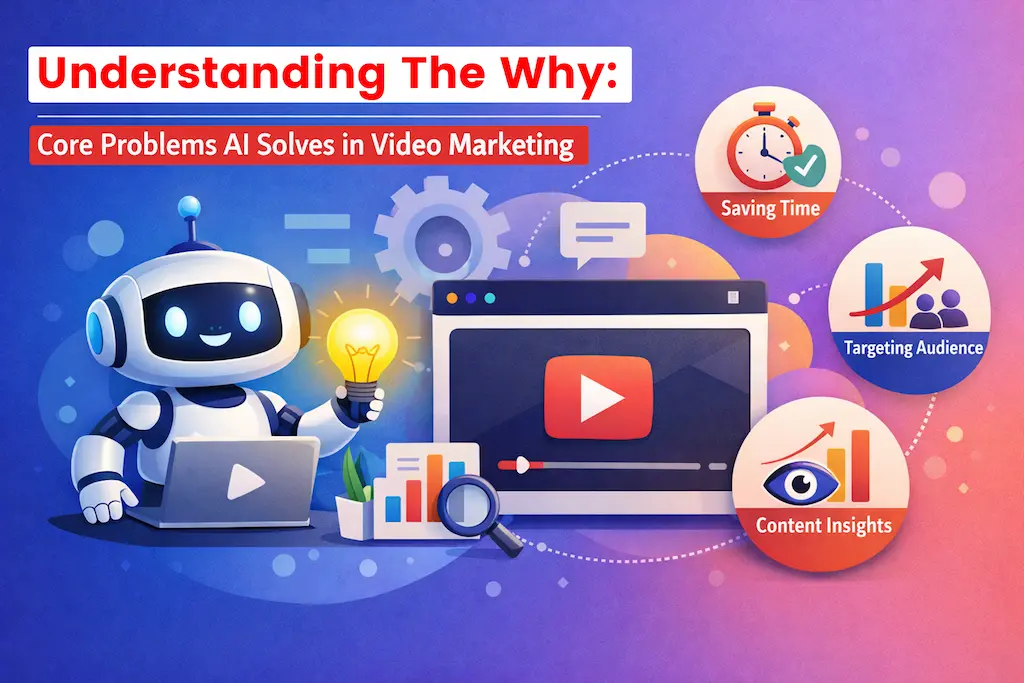
Understanding the “Why”: Core Problems AI Solves in Video Marketing
Before investing in tools or redesigning workflows, it’s critical to understand why AI has become essential in video marketing. The shift isn’t driven by hype it’s driven by very real operational bottlenecks that limit growth.
Let’s break down the core problems AI directly addresses.
1. The High Cost & Time Sink of Traditional Video Production
Traditional video production is expensive and slow. You need equipment, studio space, on-screen talent, editors, designers, and often multiple revision cycles. Even a short promotional video can take weeks to move from concept to launch.
The Agitation
For marketing managers and SMB owners, this creates a painful tradeoff:
- Either produce fewer videos due to budget constraints
- Or sacrifice quality to reduce costs
Meanwhile, competitors are publishing consistently across platforms, testing formats, and iterating quickly. The speed gap becomes a competitive gap.
The AI Solution
AI dramatically compresses production timelines by automating repetitive and technical tasks:
- Automated script generation and storyboard drafting
- AI-powered video editing and scene generation
- Virtual avatars and voiceovers replacing studio shoots
- Automated subtitles, translations, and formatting
What once took weeks can now be done in days or even hours. This reduces dependency on large production teams and allows marketing departments to shift focus from logistics to strategy.
Business Impact:
- Lower production costs
- Faster campaign launches
- Increased publishing frequency
- Higher content output without scaling headcount
2. Scaling Personalization for Diverse Audiences
The Problem
Modern audiences expect relevance. A single generic video no longer performs well across multiple segments, buyer personas, and platforms.
But creating personalized versions manually?
It’s resource-intensive and operationally complex.
The Agitation
Without personalization:
- Engagement drops
- Watch time decreases
- Conversion rates stagnate
- Paid media becomes inefficient
Marketing teams know personalization works but scaling it feels impossible.
The AI Solution
AI enables dynamic content personalization at scale:
- Automated adaptation of messaging for different audience segments
- Dynamic name, industry, or behavior-based content insertion
- AI-driven recommendation engines
- Platform-specific formatting and optimization
Instead of creating one video for everyone, you can create modular content that AI customizes per audience group.
Business Impact:
- Higher click-through rates
- Improved retention and watch time
- Increased conversion rates
- Better paid media efficiency
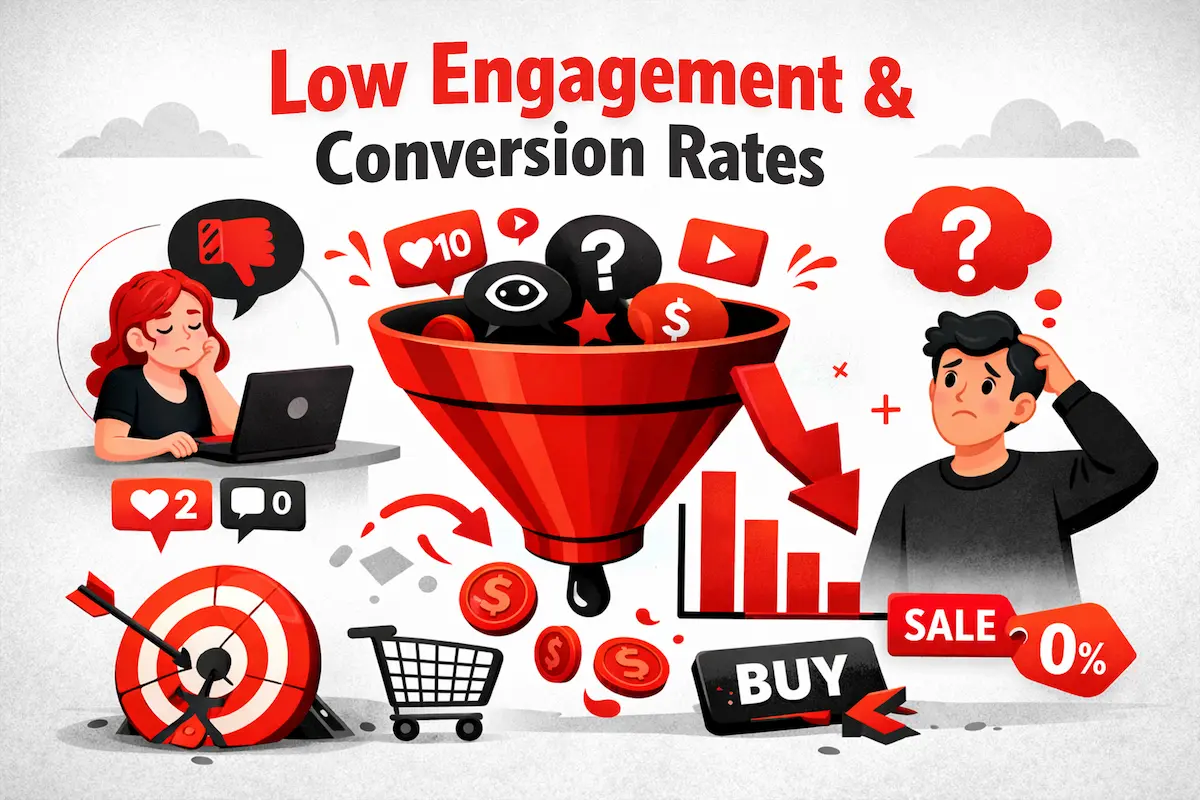
3. Low Engagement & Conversion Rates
The Problem
Many businesses invest in video but struggle with results. Content feels polished yet engagement remains flat.
The issue isn’t always production quality. It’s alignment.
The Agitation
Without data-backed insights:
- Topics are chosen based on intuition
- Creative decisions rely on guesswork
- Optimization happens after campaigns underperform
This “publish and hope” approach drains budgets and morale.
The AI Solution
AI introduces predictive intelligence into the creative process:
- Predictive analytics to identify high-performing topics
- Sentiment analysis to refine messaging tone
- Automated A/B testing at scale
- Real-time performance optimization
Instead of guessing what might work, teams can make decisions based on behavioral data and predictive modeling.
Business Impact:
- Improved engagement metrics
- Higher completion rates
- More qualified leads
- Smarter allocation of ad spend
4. Content Creation & Ideation Fatigue
The Problem
Video marketing requires consistent output. Platforms reward frequency and freshness. But generating new ideas continuously is exhausting.
The Agitation
Marketing teams often face:
- Creative burnout
- Repetitive content themes
- Slow brainstorming cycles
- Missed trend opportunities
When ideation stalls, content momentum drops.
The AI Solution
AI-powered tools can support creative teams by:
- Generating script drafts and hooks
- Identifying trending topics within specific niches
- Analyzing competitor content gaps
- Repurposing long-form content into multiple short-form videos
AI doesn’t replace creativity it accelerates it. It provides a starting point, surfaces patterns, and reduces blank-page friction.
Business Impact:
- Faster content cycles
- More diverse formats
- Stronger alignment with trends
- Reduced creative fatigue
5. Measuring True Impact and ROI
The Problem
Many video campaigns are measured using vanity metrics: views, likes, shares. But leadership wants revenue impact, not surface-level engagement.
The Agitation
Without clear attribution:
- Video budgets are questioned
- Marketing teams struggle to justify investment
- Optimization becomes reactive
This creates internal friction and limits long-term scaling.
The AI Solution
AI-driven analytics go beyond surface metrics:
- Advanced audience behavior tracking
- Multi-touch attribution modeling
- Predictive ROI forecasting
- Automated insights on drop-off points and conversion triggers
This transforms video marketing from a creative expense into a measurable revenue driver.
Business Impact:
- Clearer performance reporting
- Stronger executive buy-in
- Data-backed scaling decisions
- Improved return on marketing investment
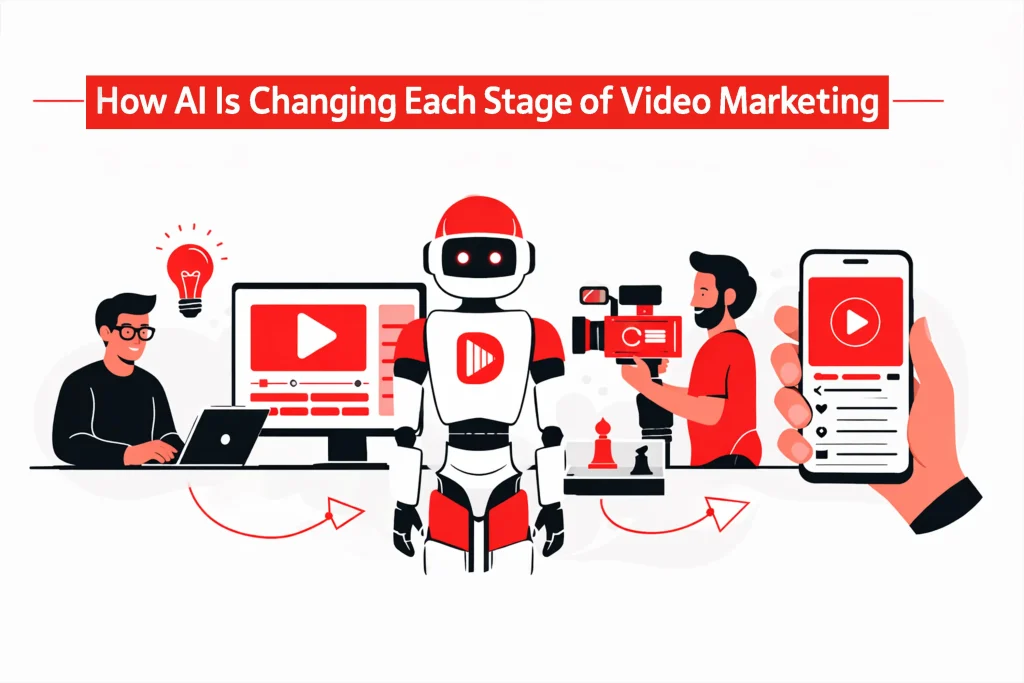
How AI Is Changing Each Stage of Video Marketing
AI isn’t just improving one part of video marketing it’s reshaping the entire workflow. From ideation to asset generation, AI enables faster execution, smarter decisions, and scalable personalization.
Let’s break it down stage by stage.
1. Pre-Production Concept, Scripting, and Planning
Pre-production is where strategy meets creativity. Traditionally, this phase involves brainstorming sessions, keyword research, scripting, revisions, and alignment meetings. It’s time-consuming and often inconsistent.
AI streamlines and strengthens this foundation.
AI for Idea Generation & Brainstorming
The Challenge:
Generating fresh, high-performing video ideas consistently is difficult. Teams rely on intuition, past performance, or competitor monitoring often reacting rather than leading.
How AI Helps:
AI tools analyze massive datasets across search trends, audience behavior, and content performance patterns. They can:
- Identify trending topics in your niche
- Surface high-intent keywords for video SEO
- Suggest new content angles based on user questions
- Analyze competitor gaps
- Generate hooks optimized for engagement
For example, tools like ChatGPT and Jasper AI can help generate:
- Video script ideas
- Attention-grabbing headlines
- Structured content outlines
- Variant messaging for different audience segments
Instead of starting from a blank page, marketing teams begin with structured, data-informed drafts.
Business Benefit:
- Faster content cycles
- More strategic ideation
- Stronger alignment with audience intent
AI-Assisted Scriptwriting & Storyboarding
The Challenge:
Even with a strong idea, scripting for engagement requires skill. Scripts must balance storytelling, clarity, persuasion, and platform optimization whether for YouTube, LinkedIn, Instagram, or paid ads.
How AI Helps:
AI tools can:
- Draft structured scripts using proven frameworks
- Suggest compelling calls to action
- Optimize tone for different buyer personas
- Shorten or expand scripts for various platform formats
- Generate multiple variations for A/B testing
For example:
- A long-form educational script for YouTube
- A condensed 30-second paid ad version
- A personalized version for retargeting audiences
AI can also assist with basic storyboarding by outlining scenes, transitions, and suggested visuals.
Expert Tip: Start Small, Scale Smart
Don’t attempt full automation immediately. Begin by using AI for repetitive, time-intensive tasks such as:
- First-draft script creation
- Hook generation
- CTA optimization
Once your team becomes comfortable, gradually integrate AI deeper into planning and personalization workflows.
Business Benefit:
- Reduced script development time
- More consistent messaging
- Faster campaign testing
2. Production Content Creation & Asset Generation
Production has historically been the most expensive and resource-intensive stage of video marketing. AI is fundamentally changing this dynamic.
AI-Powered Virtual Avatars & Text-to-Video
The Challenge:
Not every business can afford on-camera talent, studio setups, or multilingual production teams. Even when budgets allow, scaling video production quickly becomes complex.
How AI Helps:
AI-powered platforms now allow businesses to create professional videos directly from text input. These tools offer:
- Realistic virtual presenters
- Natural-sounding AI voiceovers
- Multilingual video generation
- Rapid scene assembly
- Template-based corporate branding
Platforms such as Synthesia, HeyGen, and Synthesys AI Studio enable marketers to:
- Turn scripts into finished videos without cameras
- Localize content for global audiences
- Produce training, onboarding, and product explainer videos at scale
This is particularly valuable for:
- Product demos
- Customer onboarding sequences
- Sales outreach videos
- Internal training modules
Business Benefit:
- Significant reduction in production costs
- Faster turnaround times
- Scalable multilingual marketing
Automated Stock Footage & Music Selection
The Challenge:
Finding relevant visuals and background music can be surprisingly time-consuming. It often requires manual browsing through large asset libraries.
How AI Helps:
AI systems can:
- Automatically recommend relevant stock footage based on script context
- Match background music to tone and pacing
- Suggest visual transitions and overlays
- Ensure brand consistency across video assets
Instead of manually searching for the right clip, AI curates assets aligned with your narrative.
Business Benefit:
- Reduced editing time
- More cohesive storytelling
- Faster project completion
The Strategic Shift
AI doesn’t eliminate the need for creative direction it amplifies it.
Marketing professionals remain responsible for:
- Strategic positioning
- Audience targeting
- Brand voice
- Performance analysis
AI simply accelerates execution and enables scale.
Post-Production Editing, Optimization, and Enhancement
If production determines quality, post-production determines performance.
Traditionally, editing is labor-intensive and highly technical. Revisions require manual cuts, captioning takes hours, and adapting videos for multiple platforms multiplies the workload.
AI compresses this complexity dramatically.
AI-Driven Editing Assistants
The Challenge:
Manual editing slows down publishing velocity. Even small changes trimming pauses, adjusting transitions, correcting background issues require skilled editors and time.
How AI Helps:
AI-powered editing tools now automate many time-consuming tasks:
- Automatic silence removal and smart cuts
- Scene detection and transition suggestions
- AI-assisted color correction
- Background removal or replacement
- Object removal from frames
Platforms like Descript allow you to edit video simply by editing text transcripts. Meanwhile, tools such as Runway and Adobe Firefly enable advanced AI-powered visual enhancements and generative editing capabilities.
Business Benefit:
- Faster editing cycles
- Reduced dependency on specialized editors
- More agile campaign iteration
Intelligent Captioning & Subtitling
The Challenge:
Captions are essential for accessibility, mobile viewing, and global reach but manual transcription is slow and error-prone.
How AI Helps:
AI-driven captioning tools provide:
- High-accuracy automatic transcription
- Multi-language subtitle generation
- Real-time caption embedding
- Keyword-highlighted captions for engagement
With mobile-first consumption dominating, captions significantly improve watch time and retention rates.
Business Benefit:
- Increased accessibility
- Improved completion rates
- Enhanced global scalability
Content Repurposing & Adaptation
The Challenge:
Each platform has unique requirements:
- Vertical short-form for TikTok
- Landscape long-form for YouTube
- Square videos for certain social feeds
- Shorter cuts for paid ads
Manually re-editing for each format drains time and resources.
How AI Helps:
AI tools can automatically:
- Resize aspect ratios (vertical, square, horizontal)
- Trim long-form videos into short clips
- Extract highlight moments
- Add platform-specific captions and overlays
Expert Tip: Optimize for Different Platforms
Use AI to repurpose one core video into multiple optimized variants. A single webinar can become:
- 5 short-form clips
- 3 social ads
- 1 email teaser
- 1 LinkedIn educational snippet
This multiplies content output without multiplying production cost.
Business Impact:
- Greater content reach
- Higher ROI per production asset
- Faster omnichannel deployment
4. Distribution Targeting & Audience Reach
Even the best video fails without strategic distribution. AI transforms distribution from broad targeting to precision marketing.
AI-Powered Audience Segmentation & Targeting
The Challenge
Manual segmentation relies on basic demographic filters. This limits personalization and wastes ad spend.
How AI Helps:
AI-driven targeting analyzes:
- Behavioral patterns
- Content consumption habits
- Purchase signals
- Engagement history
It identifies high-intent audiences and dynamically adjusts placements to maximize performance.
This results in:
- Smarter retargeting
- Better audience clustering
- More efficient paid campaigns
Business Benefit:
- Lower cost per acquisition
- Higher conversion rates
- Reduced wasted ad spend
Predictive Performance Analysis
The Challenge:
Most teams evaluate performance after launch when budget has already been spent.
How AI Helps:
AI-powered systems can forecast potential performance by analyzing:
- Historical engagement trends
- Topic resonance
- Platform behavior patterns
- Audience match probability
This allows teams to refine messaging and targeting before significant spend.
Platforms like TubeBuddy and vidIQ provide AI-driven YouTube SEO insights, competitive analysis, and content scoring to inform strategic decisions.
Business Benefit:
- Smarter content selection
- Reduced risk in campaign launches
- Data-backed video strategy
Ready to Scale Video Marketing with AI
5. Analysis: Performance Tracking & Optimization
This is where AI delivers compounding value.
Without clear measurement, video marketing becomes guesswork. With AI-driven analytics, it becomes a scalable growth engine.
Advanced Video Analytics & Insights
The Challenge:
Basic metrics like views and likes don’t reveal true business impact.
How AI Helps:
AI-powered analytics platforms provide:
- Viewer engagement heatmaps
- Drop-off point analysis
- Conversion path tracking
- Behavior-based segmentation
- Multi-touch attribution insights
Platforms such as Vidyard and Wistia combine hosting, personalization, and advanced analytics often integrating AI-powered insights into performance dashboards.
Business Benefit:
- Clear attribution
- Improved funnel optimization
- Stronger executive reporting
A/B Testing & Iteration at Scale
The Challenge:
Testing variations manually is slow and limited.
How AI Helps:
AI enables rapid experimentation with:
- Different hooks
- Thumbnail variations
- CTAs
- Script lengths
- Personalization elements
It can automatically identify winning combinations and shift budget allocation dynamically.
Expert Tip: Measure Everything
To maximize AI’s impact:
- Track views, watch time, and engagement
- Monitor drop-off points
- Attribute conversions accurately
- Compare AI-enhanced videos vs. traditional production
Continuous measurement allows iterative refinement turning video marketing into a data-driven performance channel rather than a creative gamble.
Key AI Video Marketing Tools & Platforms for Businesses (With Use Cases)
To effectively integrate AI into your video marketing strategy, it’s essential to understand the landscape of tools available what they do, how they help, and when to use them. The table below provides a snapshot of the most impactful platforms in 2026, highlighting core functions, standout AI features, and practical business use cases.
Tool Name | Primary Function | Key AI Feature | Best For (Use Case) | Pricing Tier |
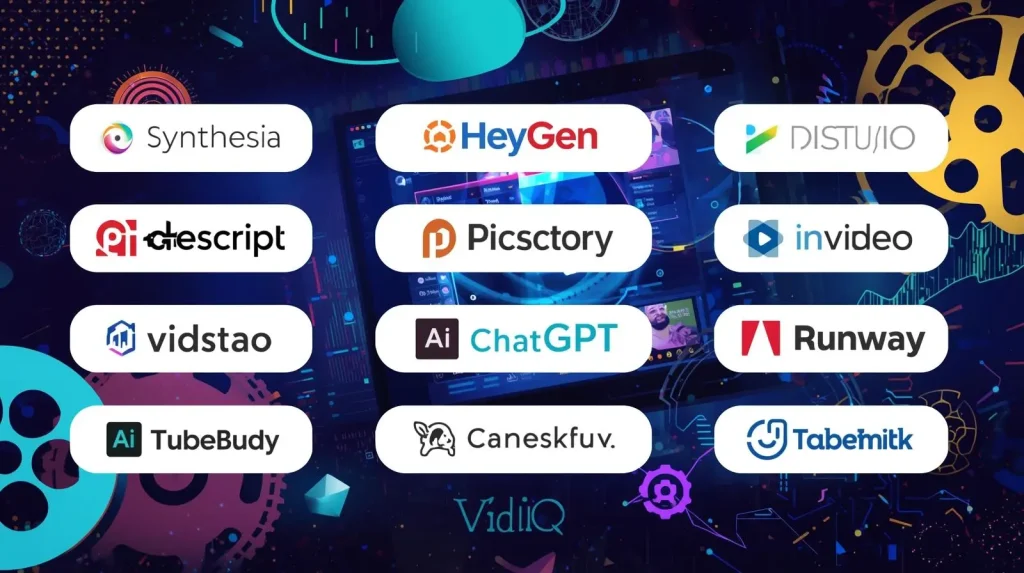
Synthesia / HeyGen / Synthesys AI Studio | AI Video & Avatar Generation | Text-to-video, realistic avatars, multilingual voiceovers | Creating explainer videos, internal training, personalized customer messages at scale | Freemium/Paid |
Descript | AI-Driven Video Editing & Transcription | “Overdub” voice cloning, filler-word removal | Editing videos like text, quick repurposing, transcription | Freemium/Paid |
Pictory / InVideo | Quick Video Creation | Text-to-video, automated summaries | Turning blog posts into videos, social snippets, quick promos | Freemium/Paid |
Vidyard / Wistia | Video Hosting, Analytics & Personalization | AI insights into viewer behavior, dynamic CTAs | Sales prospecting, personalized outreach, performance analytics | Paid |
ChatGPT / Jasper AI | Content Generation & Scripting | Natural language processing, idea generation | Brainstorming concepts, writing scripts, generating headlines & descriptions | Freemium/Paid |
Runway / Adobe Firefly | Advanced AI Video Editing & Effects | Generative fill, object removal, AI motion tracking | High-end editing, creative effects, prototyping video concepts | Paid |
TubeBuddy / vidIQ | YouTube SEO & Channel Optimization | Keyword research, competitor analysis, trend prediction | Optimizing YouTube videos for search, channel growth planning | Freemium/Paid |
How to Use This Table Strategically
Early-Stage Content Planning:
Use AI assistants like ChatGPT or Jasper to brainstorm topics, hooks, and scripts before production begins. Their ability to process language and audience intent accelerates ideation.
Production Efficiency:
If you need high-quality videos without large production teams, platforms like Synthesia and HeyGen are transformational. They enable text-to-video generation with human-like avatars and multilingual voiceovers.
Editing & Repurposing:
Descript excels where speed and flexibility matter especially for repurposing long-form content, removing filler words, and testing multiple variants with minimal effort.
Performance & Optimization:
Vidyard and Wistia combine hosting with AI-driven analytics, enabling personalized CTAs, viewer behavior insights, and detailed ROI attribution making them strong choices for sales and performance-focused teams.
Platform-Specific Growth:
Tools like TubeBuddy and vidIQ are essential for anyone serious about YouTube. Their AI insights help identify keywords, predict trends, and plan content that fuels channel growth.
Expert Implementation Tips
Mix Tools Based on Workflow Stage
No single platform handles every need. Pair ideation tools with production and analytics tools to build a seamless, AI-powered video stack.
Start Within Budget Constraints
Leverage freemium tiers where available to test impact before committing to paid plans. Many offer sufficient functionality for early experimentation.
Measure Tool ROI
Track time saved, engagement uplift, and conversion improvements after integrating specific tools this strengthens internal buy-in and budget allocation.
When used strategically, these platforms transform video marketing from a costly creative process into a data-driven growth engine.
Benefits for Businesses The ROI of AI-Powered Video Marketing
AI in video marketing is not just about innovation it’s about measurable business impact. For marketing leaders and business owners, the real question isn’t “Is AI impressive?”
It’s: Does it improve ROI?
When implemented strategically, the answer is a clear yes. Here’s how.
1. Increased Efficiency & Faster Production Cycles
The Business Challenge
Video marketing often slows down campaigns. Production bottlenecks delay launches. Editing cycles stretch timelines. By the time a video goes live, the market opportunity may have shifted.
How AI Improves Efficiency
AI automates repetitive, time-intensive tasks such as:
- Script drafting
- Transcription and captioning
- Silence and filler-word removal
- Clip extraction from long-form content
- Format adaptation for different platforms
This dramatically reduces time-to-market.
Instead of:
- 3–4 weeks from idea to launch
You may achieve: - 3–5 days for AI-assisted production workflows
Practical “How-To” Implementation Steps
To demonstrate real operational value, follow this phased approach:
Step 1: Identify Repetitive Bottlenecks
Audit your current workflow. Where does time accumulate? (Script revisions, captioning, resizing videos?)
Step 2: Automate One Layer at a Time
Start with:
- AI script generation
- Automated transcription
- Auto-formatting for social platforms
Step 3: Measure Time Saved
Track:
- Production cycle time before AI
- Production cycle time after AI
This quantifies efficiency gains for leadership reporting.
Business Impact:
- Faster campaign launches
- Higher publishing frequency
- More agile response to trends
2. Significant Cost Reduction
The Business Challenge
Traditional production requires:
- Studio rentals
- Professional camera equipment
- Editors and motion designers
- On-screen talent
- Multiple retakes and revisions
These costs add up quickly especially for SMBs.
How AI Reduces Costs
AI video platforms eliminate or reduce:
- Need for physical studio setups
- Dependence on large crews
- Re-shoots for small script changes
- Separate multilingual production budgets
A single script can now generate:
- Multiple language versions
- Personalized audience variants
- Platform-specific cuts
All without re-recording.
Strategic Resource Optimization
Instead of allocating budget to:
- Repetitive production tasks
Reallocate it toward:
- Paid distribution
- Performance testing
- Creative strategy
- Funnel optimization
Business Impact:
- Lower cost per video asset
- Higher ROI per campaign
- Scalable production without headcount growth
3. Enhanced Personalization at Scale
The Business Challenge
Generic video content no longer converts effectively. Buyers expect relevance.
Yet manually creating personalized variants for each audience segment is operationally unrealistic.
How AI Enables Hyper-Personalization
AI-driven systems allow you to:
- Segment audiences by behavior and intent
- Insert dynamic elements into video (names, industries, offers)
- Adjust messaging based on buyer stage
- Deliver retargeting-specific video variants
This transforms video from a broadcast tool into a conversion engine.
Expert Tip: Leverage AI for Personalization
Use AI analytics to:
- Identify high-intent audience clusters
- Map content to each stage of the buyer journey
- Create modular scripts that AI can dynamically adapt
For example:
SaaS Company Use Case:
- Version 1: Awareness-focused educational video
- Version 2: Retargeting video addressing objections
- Version 3: Industry-specific case study variation
All generated from one core framework.
Business Impact:
- Higher watch time
- Increased click-through rates
- Improved sales conversion rates
4. Improved Engagement & Higher Conversion Rates
The Business Challenge
Many businesses produce “good-looking” videos that underperform. The issue isn’t quality it’s optimization.
How AI Improves Engagement
AI enhances performance by:
- Identifying high-retention content structures
- Analyzing viewer drop-off points
- Predicting which hooks increase watch time
- Testing multiple CTA variations automatically
Instead of guessing what works, teams rely on behavioral data.
Practical Examples Across Industries
E-commerce Brand:
Uses AI to analyze which product demo segments drive the highest retention. Shortens underperforming sections → increases add-to-cart conversions.
B2B Service Provider:
Uses AI-driven personalized video outreach in sales emails. Embeds prospect-specific messaging → increases response rates.
Online Educator:
Repurposes long-form webinars into short, AI-extracted highlight clips optimized for social media → improves funnel entry rates.
These are not hypothetical improvements they are workflow enhancements that directly impact conversion performance.
Business Impact:
- Higher completion rates
- Improved lead quality
- Increased revenue per campaign
5. Data-Driven Decision Making
The Business Challenge
Without detailed analytics, video marketing becomes subjective. Leadership wants measurable impact not vanity metrics.
How AI Enables Smarter Decisions
AI-powered analytics platforms provide:
- Engagement heatmaps
- Audience behavior tracking
- Drop-off analysis
- Conversion attribution
- Predictive performance modeling
This transforms reporting from:
“Here’s how many views we got.”
To:
“Here’s how video influenced pipeline and revenue.”
Continuous Optimization Loop
AI enables a feedback cycle:
- Launch video
- Collect behavioral data
- Identify friction points
- Automatically test variations
- Scale winning versions
This iterative loop compounds ROI over time.
Business Impact:
- Stronger executive buy-in
- Better marketing budget allocation
- Predictable performance scaling
The Bottom Line: AI as a Growth Multiplier
When implemented strategically, AI-powered video marketing delivers:
- Faster production
- Lower costs
- Personalized experiences
- Higher engagement
- Clearer ROI attribution
The competitive advantage doesn’t come from simply using AI.
It comes from integrating AI across the full video marketing lifecycle planning, production, personalization, distribution, and optimization.
For businesses willing to adopt a structured, data-driven approach, AI is not just a tool.
It’s a scalable growth engine.
Challenges & Considerations: Navigating the AI Video Landscape
AI unlocks massive efficiency and scalability but it’s not without risks.
For marketing leaders and business owners, responsible adoption is just as important as strategic adoption. Ignoring the human, ethical, and operational considerations can damage brand trust faster than AI can accelerate growth.
Here’s how to navigate the landscape intelligently.
1. Maintaining Authenticity & Human Touch
The Risk
AI-generated content can sometimes feel generic, templated, or emotionally flat. If overused without refinement, it may dilute brand identity or create a “robotic” tone.
For brands built on trust and personality, this is a real concern.
The Reality
AI does not replace creativity it accelerates production. But without human oversight, it can default to safe, predictable patterns.
Strategies to Preserve Authenticity
- Use AI for drafts, not final output
- Inject brand-specific tone, vocabulary, and storytelling
- Add real customer stories and lived experiences
- Customize visuals, music, and pacing to reflect brand personality
- Align scripts with emotional triggers specific to your audience
Expert Tip: Prioritize Authenticity
Always review AI-generated scripts and visuals through a brand lens. Your marketing team should refine messaging, adjust tone, and add human nuance before publishing.
Addressing a Common Misconception
“Will AI replace human creativity?”
No. AI excels at:
- Data processing
- Pattern recognition
- Automation
- Speed
Humans excel at:
- Emotional storytelling
- Strategic positioning
- Cultural awareness
- Brand differentiation
The most effective video strategies combine AI’s efficiency with human creative leadership.
2. Ethical Concerns: Deepfakes, Bias & Transparency
As AI video capabilities grow, so do ethical responsibilities.
Responsible Use of Synthetic Media
AI avatars and voice cloning tools can be powerful but misuse can erode trust.
Businesses must avoid:
- Impersonation without consent
- Misleading “real person” representations
- Manipulated footage presented as authentic
Transparency builds long-term credibility.
Expert Tip: Ethical AI Is Key
If AI-generated presenters, voiceovers, or visuals are used, disclose appropriately where relevant. Avoid any deceptive representation.
Avoiding Algorithmic Bias
AI systems are trained on large datasets. If those datasets contain bias, outputs may unintentionally reinforce stereotypes or exclude certain demographics.
To mitigate this risk:
- Review targeting segments carefully
- Audit AI-generated scripts for language sensitivity
- Avoid over-segmentation that may unintentionally discriminate
- Diversify training inputs and creative review teams
Ethical marketing is not optional it’s a competitive differentiator.
AI Video Marketing Ethics Checklist for Brands
Use this checklist before launching AI-powered video campaigns:
✔ Transparency
- Are AI-generated elements disclosed where appropriate?
- Is there any potential for audience confusion about authenticity?
✔ Bias Mitigation
- Has the script been reviewed for biased language or assumptions?
- Are targeting criteria ethically and legally sound?
✔ Data Privacy
- Is personalized data used responsibly?
- Are consent and opt-in requirements clearly followed?
✔ Accuracy & Factual Integrity
- Has AI-generated information been fact-checked?
- Are statistics and claims verified before publishing?
✔ Brand Alignment
- Does the final output reflect your brand voice and values?
This checklist protects not only compliance but long-term trust.
3. Data Privacy & Security
Personalized video marketing relies on audience data. With that comes responsibility.
Key Risks
- Misuse of behavioral tracking data
- Insecure storage of customer information
- Non-compliance with regulations such as GDPR or CCPA
- Over-personalization that feels intrusive
Best Practices
- Use secure, compliant video hosting platforms
- Avoid embedding sensitive personal data directly into video files
- Ensure opt-in consent for personalized marketing
- Work closely with legal or compliance teams
Privacy is no longer a back-office issue it’s part of brand reputation.
4. The Learning Curve & Integration Complexity
AI tools are powerful but adoption requires operational change.
Common Challenges
- Teams unfamiliar with AI workflows
- Resistance to process changes
- Integration with existing CRM and marketing systems
- Tool overload and fragmentation
Integration Strategies for Existing Tech Stacks
To avoid disruption:
- Start With Compatibility
Choose AI video tools that integrate with:
- CRM systems (e.g., for sales personalization)
- Marketing automation platforms
- Email marketing tools
- Social media schedulers
- Pilot Within One Team
Test AI video integration in a single campaign or department before scaling company-wide. - Document Standard Operating Procedures (SOPs)
Create clear workflows for:
- Script approval
- AI tool usage
- Data privacy compliance
- Performance reporting
- Train Strategically, Not Just Technically
Don’t just teach teams how to use the tools teach them when and why to use them.
This structured approach minimizes friction and accelerates ROI realization.
5. Over-Reliance on AI Without Human Oversight
The biggest risk isn’t using AI.
It’s using it blindly.
AI can:
- Suggest scripts
- Predict performance
- Automate editing
But it cannot:
- Understand your long-term brand positioning
- Replace strategic judgment
- Fully grasp cultural nuance
- Make ethical decisions
Expert Tip: Combine AI With Human Expertise
AI should handle automation and analysis. Humans should handle strategy and storytelling.
The strongest AI video marketing programs operate as a partnership:
- AI provides speed and data
- Humans provide meaning and direction
The Strategic Perspective
AI video marketing offers extraordinary potential but only when implemented responsibly.
Brands that will win in this space are those that:
- Prioritize authenticity
- Maintain ethical standards
- Protect customer data
- Integrate tools strategically
- Combine automation with human creativity
AI is not a shortcut.
It is a force multiplier when guided by thoughtful leadership.
A Step-by-Step Guide to Integrating AI into Your Video Marketing Strategy
Integrating AI into your video marketing isn’t just about adopting new tools it’s about building a structured, strategic workflow that enhances efficiency, creativity, and ROI. Follow this practical roadmap to implement AI successfully.
Step 1: Audit Your Current Video Marketing Efforts
Objective: Understand where AI can have the greatest impact.
Actions:
- Map your existing video production workflow from ideation to distribution.
- Identify bottlenecks (e.g., slow editing, repetitive tasks, manual personalization).
- Assess internal expertise: Which team members are comfortable with AI tools? Where is training needed?
Outcome: A clear understanding of pain points, inefficiencies, and opportunities for AI-driven improvement.
Step 2: Define Clear Objectives for AI Integration
Objective: Establish measurable goals to guide your AI adoption.
Actions:
- Specify what problems you want AI to solve, such as:
- Reducing production time by X%
- Increasing personalized video variations by Y%
- Improving engagement or conversion metrics
- Set KPIs to measure success (e.g., watch time, completion rate, lead conversion).
Expert Tip: Focus on Problem-Solving
Start with challenges rather than tools. Identify your top video marketing pain points, then explore AI solutions that directly address them.
Step 3: Research & Select the Right AI Tools
Objective: Match AI solutions to your goals, budget, and skill set.
Actions:
- Evaluate AI tools for their features, ease of use, and scalability.
- Check compatibility with your existing tech stack (CRM, marketing automation, social media management).
- Consider cost vs. value: Freemium tiers are great for experimentation; paid plans often unlock advanced functionality.
Differentiation Opportunity: Interactive Tool Comparison
Create a simple comparison table to select the best AI tool for your business needs based on:
- Use case (e.g., scriptwriting, editing, analytics)
- Pricing
- Platform integration
- Team learning curve
Step 4: Start Small with Pilot Projects
Objective: Test AI capabilities without high risk.
Actions:
- Pick a low-stakes project such as:
- Generating initial script outlines
- Simple video edits or captioning tasks
- Run the project, collect data, and gather team feedback.
Expert Tip: Start Small, Scale Smart
Begin with repetitive tasks to build confidence, then expand AI integration gradually to more complex workflows.
Step 5: Train Your Team & Develop New Workflows
Objective: Ensure smooth adoption and synergy between humans and AI.
Actions:
- Provide hands-on training on chosen AI tools.
- Update workflow documentation to reflect AI-assisted processes.
- Encourage collaboration between AI-powered efficiency and human creativity (e.g., editing AI scripts, refining personalized video outputs).
Outcome: Teams gain confidence using AI while maintaining quality and authenticity.
Step 6: Measure, Analyze, and Iterate
Objective: Make AI adoption data-driven and continuously improving.
Actions:
- Track KPIs defined in Step 2 (engagement, retention, conversions, production time).
- Analyze AI-driven insights to understand which strategies are working.
- Adjust workflows, content formats, or targeting based on results.
Expert Tip: Measure Everything
Robust analytics are key. Use AI-enhanced video platforms to gather granular data, test multiple variations, and refine campaigns continuously.
Step 7: Scale Up & Expand AI Integration
Objective: Move from pilot projects to full-scale AI adoption.
Actions:
- Introduce AI into more complex or broader initiatives:
- Multi-platform video campaigns
- Dynamic personalization at scale
- Predictive performance optimization
- Explore advanced AI capabilities: generative visuals, sentiment-based content adaptation, or automated distribution strategies.
Outcome: AI becomes a core component of your video marketing strategy improving efficiency, engagement, and ROI across campaigns.
Future Trends: What’s Next for AI in Video Marketing
AI is evolving at a breakneck pace, and its impact on video marketing will continue to accelerate. Forward-thinking businesses that anticipate these trends can gain a competitive edge, create more engaging content, and build deeper connections with audiences. Here’s a glimpse of what’s on the horizon.
1. Hyper-Realistic Synthetic Media & Virtual Influencers
Trend:
AI-generated humanoids, virtual avatars, and fully synthetic environments are becoming indistinguishable from reality. Brands are experimenting with virtual spokespeople, influencers, and customer service representatives that exist entirely in digital form.
Implications:
- Provides limitless scalability for video production
- Reduces reliance on human talent for certain campaigns
- Raises ethical questions about authenticity and disclosure
Expert Insight:
Marketing leaders emphasize the importance of transparency and brand alignment when using virtual influencers to maintain audience trust.
2. AI-Driven Real-Time Video Personalization
Trend:
Dynamic content that adapts in real time to individual viewer behavior is emerging as a major differentiator. AI can modify video elements offers, visuals, messaging instantly based on:
- Viewing history
- Engagement patterns
- Demographic or location data
Applications:
- Personalized live streams for events
- Real-time product recommendations in marketing videos
- Adaptive learning modules in e-learning platforms
Business Benefit:
Enhanced engagement and retention by giving each viewer a unique, relevant experience.
3. Predictive AI for Content Creation & Trends
Trend:
AI is moving beyond reactive generation to predictive creation. By analyzing massive datasets, AI can:
- Anticipate trending topics before they go viral
- Suggest new video concepts aligned with emerging consumer interests
- Forecast performance metrics for different content types.
4. Advanced AI for Video Accessibility & Inclusivity
Trend:
AI is enabling inclusive video experiences at scale:
- Automated sign language translation
- Real-time audio descriptions
- AI-generated captions in multiple languages
Impact:
Ensures broader audience reach and compliance with accessibility standards while enhancing brand reputation.
5. The Metaverse & Spatial Video Experiences
Trend:
AI will play a central role in creating immersive, interactive videos for virtual and augmented reality spaces:
- Spatially aware video content
- Interactive product demos within 3D environments
- Engaging virtual events or branded experiences
Business Potential:
Brands adopting spatial video early can capture attention in immersive environments, establishing a first-mover advantage.
Expert Tip: Stay Updated on AI Trends
The AI video marketing landscape evolves rapidly. To remain competitive:
- Regularly research new AI tools, platforms, and features
- Monitor industry reports such as Gartner’s Marketing Technology Trends or HubSpot’s AI Marketing Insights
- Test emerging features cautiously in pilot projects before full-scale adoption
The Strategic Takeaway
The next frontier of AI video marketing will focus on:
- Hyper-realism
- Personalization at scale
- Predictive intelligence
- Accessibility
- Immersive experiences
Businesses that integrate these innovations responsibly combining AI efficiency with human creativity, ethical standards, and brand authenticity will not only stay relevant but shape the future of video marketing.
FAQs The AI Revolution in Video Marketing
What is AI video marketing, and how does it differ from traditional video marketing?
AI video marketing leverages artificial intelligence to automate, optimize, and personalize video creation, editing, and distribution. Unlike traditional approaches, AI reduces production time, scales personalization, provides predictive insights, and enables data-driven decision-making, improving ROI and audience engagement.
Can AI-generated videos feel authentic, or do they seem robotic?
When used thoughtfully, AI-generated videos can feel highly authentic. By combining AI efficiency with human oversight including brand voice, emotional storytelling, and creative direction businesses can produce videos that resonate with audiences while maintaining a natural, engaging tone.
Which types of businesses benefit most from AI video marketing tools?
AI video marketing tools are valuable for businesses of all sizes from SMBs to large enterprises. Marketing teams, content creators, e-commerce brands, SaaS companies, and digital agencies benefit most, especially when they want to:
- Produce videos faster and at lower cost
- Deliver personalized content at scale
- Optimize engagement and conversion metrics
How do I start integrating AI into my video marketing strategy?
Begin with a structured, step-by-step approach:
- Audit your current video workflows and identify pain points.
- Define clear objectives and measurable KPIs.
- Select AI tools aligned with your goals and tech stack.
- Run small pilot projects to test AI capabilities.
- Train your team and develop new workflows.
- Measure results, iterate, and scale gradually.
What are the ethical considerations when using AI in video marketing?
Responsible AI use is essential. Businesses should:
- Maintain transparency about AI-generated content
- Avoid misleading or deepfake videos
- Mitigate algorithmic bias in scripts and targeting
- Ensure data privacy and compliance with regulations (e.g., GDPR, CCPA)
- Combine AI with human oversight to preserve authenticity and trust
Conclusion: Embracing the AI-Driven Video Marketing Era
The AI revolution in video marketing is no longer a distant possibility it’s already reshaping how businesses create, distribute, and optimize content.
AI addresses the most pressing challenges in traditional video marketing:
- Efficiency & Faster Production: Automating repetitive tasks reduces time-to-market.
- Cost Savings: Lower reliance on expensive equipment, studios, and large teams.
- Personalization at Scale: Deliver hyper-relevant content tailored to audience segments.
- Enhanced Engagement & ROI: Predictive analytics and AI-optimized content improve retention and conversions.
- Data-Driven Decisions: Granular insights enable continuous optimization and measurable performance.
By integrating AI thoughtfully, businesses can transform video marketing from a labor-intensive effort into a data-driven growth engine.