
Why Video Marketing is Non-Negotiable for Roofing Businesses
Great Roofers Are Invisible Online
In today’s competitive roofing market, being good at what you do is no longer enough.
You might deliver flawless installations, respond quickly to service calls, and have years of experience but if homeowners can’t see that expertise online, they move on to the next contractor.
Many roofing business owners are experiencing the same frustration:
- Referrals aren’t as consistent as they used to be
- Paid ads are getting more expensive
- Competitors seem to dominate Google and social media
- Potential customers are “shopping around” longer before calling
Traditional marketing methods yard signs, flyers, even static website pages are struggling to cut through the noise.
The harsh reality?
If you’re not visible and trustworthy online, you’re practically invisible to today’s homeowner.
And for many roofers, digital marketing feels overwhelming:
- “Where do I even start?”
- “I don’t have a big budget.”
- “I’m not comfortable being on camera.”
- “I don’t have time to learn video editing.”
So they delay.
Meanwhile, competitors who are using simple video content are building trust faster and closing more jobs.
Trust Is the Real Currency in Roofing
Roofing is not an impulse purchase.
It’s high-ticket.
It’s urgent.
And it requires a massive amount of trust.
When a homeowner searches:
“roof repair near me”
“best roofing contractor in united state”
They’re not just comparing prices.
They’re asking:
- Can I trust this company?
- Will they show up?
- Are they experienced?
- Will they damage my property?
- Will they stand behind their work?
Text and stock photos don’t answer those questions effectively.
But video does.
Imagine a potential customer watching:
- A short video explaining your inspection process
- A before-and-after transformation of a roof replacement
- A clip of you answering common insurance claim questions
- A testimonial from a happy local homeowner
Before they ever call you, they already feel like they know you.
That’s powerful.
And here’s the shift:
Video isn’t about being “fancy.” It’s about being real, visible, and trustworthy.
From Smartphone to Sales
Here’s the good news:
You do not need:
- Expensive cameras
- A production crew
- Advanced editing skills
- A marketing agency charging thousands per month
Most successful local roofing video content today is filmed on a smartphone.
What matters is:
- Clarity
- Authenticity
- Consistency
- Strategic distribution
When done correctly, video marketing helps you:
- Show your craftsmanship in action
- Introduce your team and humanize your brand
- Answer customer objections before they arise
- Rank better in local search
- Increase time spent on your website
- Improve conversion rates from traffic to leads
Video shortens the trust cycle.
Instead of needing 7–10 touchpoints before calling, homeowners often reach out after just 1–2 strong video impressions.
Laying the Foundation: Understanding Your Audience & Setting Goals
Before you record a single video, you need clarity. Most roofing businesses fail at video marketing for one simple reason: They create content without knowing exactly who they’re talking to and what they want that video to achieve.
If you skip this step, you’ll waste time filming videos that get views but not leads.
Understanding Your Target Audience: Who Are You Talking To?
Video marketing works best when it feels personal.
The homeowner watching your video should feel like:
“This roofer understands exactly what I’m dealing with.”
That only happens when you define your audience clearly.
Step 1: Define Your Ideal Client Profile (ICP)
Instead of targeting “anyone who needs roofing,” narrow it down.
For most roofing businesses, your audience typically falls into one or more of these categories:
1. Homeowners
First-Time Homeowners
- Nervous about large repair costs
- Don’t understand roofing terminology
- Need education and reassurance
- Concerned about being overcharged
Repeat Homeowners
- Have dealt with roof repairs before
- More price-aware
- Care about workmanship warranties
- Compare multiple contractors
Storm-Damage Clients
- Urgent need
- Dealing with insurance claims
- Emotionally stressed
- Want fast, reliable help
Each of these groups requires slightly different messaging.
2. Property Managers
- Focused on maintenance schedules
- Care about long-term durability
- Need fast turnaround
- Require professional documentation
- Often compare bids based on reliability and communication
They respond better to:
- Process-driven videos
- Maintenance plan explanations
- Case studies
- Professionalism and efficiency messaging
3. Commercial Clients
- Decision-making is more structured
- Higher ticket projects
- Care deeply about safety compliance
- Want proof of experience
For them, your videos should highlight:
- Past commercial projects
- Safety protocols
- Certifications
- Crew size and capability
- Timeline management
Step 2: Understand Demographics, Psychographics & Geography
This is where you move from generic marketing to strategic marketing.
Ask yourself:
Demographics
- What income range can afford your services?
- Are they in older neighborhoods?
- Are they in storm-prone areas?
Psychographics
- Are they risk-averse?
- Do they prioritize quality over price?
- Are they insurance-dependent?
- Do they value local family-owned businesses?
Geographic Location
- Which neighborhoods generate the most revenue?
- Are certain areas prone to hail, wind, or heat damage?
- Do certain zip codes convert better?
When you mention specific neighborhoods, storm patterns, or local issues in your videos, trust increases instantly.
This demonstrates real-world experience not generic advice.
Audience Pain Points What Problems Are They Actually Facing?
Your videos should not start with:
“We are ABC Roofing, serving the area for 20 years.”
They should start with the customer’s problem.
Here are the most common roofing-related pain points:
- “I just had a storm is my roof damaged?”
- “My roof is 20+ years old. Do I need a full replacement?”
- “Why is my ceiling leaking?”
- “How much will this cost?”
- “Will insurance cover this?”
- “How do I know if a roofer is trustworthy?”
If your videos directly address these questions, you instantly position yourself as:
- Helpful
- Transparent
- Knowledgeable
- Trustworthy
That’s how you build authority without bragging.
Tailor Video Content to Their Information-Seeking Behavior
Different clients search differently.
Storm damage clients search:
“roof repair after hail in [city]”
First-time homeowners search:
“how to know if roof needs replacement”
Property managers search:
“commercial roof maintenance contractor [city]”
Your content should match those search patterns.
Examples:
- “5 Signs Your Roof Has Storm Damage in [City Name]”
- “How Insurance Roof Claims Work in [Your State]”
- “Roof Replacement Timeline: What Homeowners Should Expect”
- “Flat Roof Maintenance Tips for Commercial Properties”
This is how you align video with local SEO and buyer intent.
Speak Like a Roofer, Not a Marketer
Most contractors copy generic marketing advice.
Instead, create videos that reflect real roofing experience:
- Show actual attic inspections.
- Explain underlayment.
- Show flashing issues.
- Break down why cheap shingles fail.
When you speak with specificity, you stand out.
You’re no longer “another roofing company.”
You’re the local roofing authority.
That’s powerful positioning.
Expert Tip: Use Problem–Solution Narratives
If you’re unsure what to say in a video, use this simple framework:
Step 1: State the Problem
“After last night’s storm, many homeowners in [area] are worried about hidden roof damage.”
Step 2: Agitate the Risk
“Even small hail cracks can lead to leaks and mold within months if ignored.”
Step 3 : Offer the Solution
“Here’s how we inspect roofs after storms and what you should look for.”
This structure:
- Shows expertise
- Demonstrates real experience
- Builds trust
- Encourages action
Every video should solve a real roofing problem.
Setting Clear Video Marketing Objectives
Now let’s talk about goals.
If you don’t define your objective, you can’t measure ROI.
And roofing businesses don’t have time for “vanity marketing.”
Your video goals should align with revenue.
1. Increase Local Brand Awareness
Goal:
When someone in your area thinks “roof repair,” they think of you.
Video helps you:
- Appear in local searches
- Show up in social feeds
- Stay top-of-mind
Awareness builds familiarity.
Familiarity builds trust.
Trust builds calls.
2. Generate Qualified Leads
This is the most important objective.
Your videos should lead to:
- Phone calls
- Contact form submissions
- Inspection bookings
Always include a clear call to action:
- “Call us for a free inspection.”
- “Book your roof assessment today.”
- “We serve [city] and surrounding areas.”
3. Build Trust and Credibility
Video allows potential clients to:
- See your face
- Hear your voice
- Watch your team work
That reduces perceived risk.
And in roofing, reducing risk increases conversions.
4. Educate Potential Clients
An educated homeowner:
- Understands pricing better
- Values quality more
- Respects professional processes
- Is less likely to haggle aggressively
Education attracts better clients.
5. Showcase Craftsmanship & Project Quality
Before-and-after videos are powerful.
Drone shots.
Time-lapse installs.
Detail work.
Show the difference between a professional install and a rushed job.
Seeing is believing.
6. Improve Local SEO Rankings
Video can:
- Increase time spent on your website
- Improve engagement signals
- Rank on YouTube (second-largest search engine)
- Appear in Google’s video results
When optimized correctly, video becomes an SEO asset not just social content.

Action Step Define Your Video Strategy in 10 Minutes
Before moving to production, answer these questions:
- Who is my primary client type?
- What are their top 5 roofing concerns?
- What geographic areas do I want to dominate?
- What is my main objective? (Leads, awareness, education?)
- What problem will my first 3 videos solve?
Write it down.
Clarity now prevents confusion later.
Crafting Your Visual Story Best Video Content Types for Roofers
Now that you know who you’re talking to and what your goals are, the next question is:
What kind of videos should a roofing business actually create?
You don’t need to go viral.
You need to be relevant, local, and trustworthy.
Let’s break down the formats that consistently generate leads for roofing contractors and how to execute them properly.
The Power of Visuals: Why These Formats Resonate
Roofing is visual by nature.
- Shingles
- Flashing
- Underlayment
- Storm damage
- Rotting decking
- Proper installation techniques
These are things homeowners struggle to understand through text alone.
1. Video Builds Emotional Trust Faster Than Words
When a homeowner sees:
- You walking a roof
- Explaining damage calmly
- Showing real inspection footage
- Speaking clearly and confidently
They subconsciously evaluate:
- Professionalism
- Experience
- Honesty
- Confidence
Video shortens the trust-building cycle dramatically.
2. Video Simplifies Complex Roofing Processes
Try explaining “ice and water shield,” “ridge vent ventilation,” or “step flashing” in text.
Now imagine showing it.
A 60-second visual explanation can eliminate confusion and reduce objections during sales conversations.That’s efficiency.
3. Video Proves Craftsmanship
Roofing is a results-driven business.
When people see:
- Clean tear-offs
- Proper underlayment installation
- Straight shingle lines
- Finished flashing detail
They see quality. And quality commands better pricing.
Essential Video Formats for Roofing Success
Let’s break down the most effective types of roofing videos and how to structure them strategically.
Customer Testimonials & Reviews
Nothing builds trust faster than another homeowner saying:
“These guys did an amazing job.”
Testimonials remove skepticism.
They answer:
- “Are they reliable?”
- “Did they finish on time?”
- “Were they honest about pricing?”
Expert Tip: Leverage User-Generated Content
You don’t need a production crew.
After completing a project, simply ask:
“Would you mind recording a short 30-second video about your experience?”
Most satisfied customers are happy to help.
Even smartphone-recorded testimonials are powerful because they feel authentic.
And authenticity beats polish.
How to Guide a Strong Testimonial
Give customers simple prompts:
- What problem were you experiencing?
- Why did you choose our company?
- How was the process?
- Would you recommend us?
Keep it short and natural.
Avoid scripts.
Real emotions convert better than rehearsed lines.
Why This Works So Well
In roofing, homeowners fear:
- Hidden costs
- Poor workmanship
- Contractors disappearing
When they see a real neighbor sharing a positive experience, perceived risk drops dramatically.
And lower risk means faster decisions.
3. Explainer Videos
This is where you position yourself as the local authority.
Explainer videos educate while subtly selling.
They work exceptionally well for:
- YouTube
- Website blog posts
- FAQ pages
- Google Business Profile
A. Roofing Material Comparison Videos
Example topics:
- “Architectural vs. 3-Tab Shingles: What’s the Difference?”
- “Metal Roof vs. Asphalt Shingles in [Your Climate]”
- “Which Roofing Material Lasts the Longest?”
Use real samples in your hand.
Show texture.
Explain lifespan differences.
Mention warranties.
This builds expert authority instantly.
B. Process Breakdown Videos
Homeowners don’t know what happens during a roof replacement.
Create a video like:
“Our 7-Step Roof Installation Process”
Walk through:
- Inspection
- Tear-off
- Deck inspection
- Underlayment installation
- Flashing installation
- Shingle placement
- Final cleanup & inspection
When you show your structured process, you communicate professionalism.
That attracts better-quality clients.
C. Problem-Solution Videos
These convert extremely well.
Examples:
- “How to Spot Hail Damage on Your Roof”
- “Why Your Roof Is Leaking Around the Chimney”
- “Signs Your Roof Ventilation Is Failing”
Use real footage from job sites.
Show:
- Cracked shingles
- Rusted flashing
- Improper nail placement
- Mold in attic spaces
Explain in plain language.
Avoid jargon overload but demonstrate technical understanding.
That balance builds credibility.
See How Video Can Grow your Business
Why These Formats Outperform Generic Marketing Videos
Many roofing companies create generic “About Us” videos.
Those are fine but they don’t convert like educational and transformation content.
Homeowners care about:
- Their roof
- Their money
- Their risk
When your content directly addresses those concerns, engagement increases.
Strategic Execution Tip: Batch Content on Job Sites
You’re already on the roof.
Use that opportunity.
On one project, you can film:
- 1 before/after video
- 1 damage explanation clip
- 1 installation process clip
- 1 testimonial
That’s four pieces of content from one job.
Efficient. Practical. Scalable.
Action Plan Your First 5 Roofing Videos
If you’re just getting started, film these:
- A before-and-after transformation
- A “How to identify storm damage” video
- A testimonial from a recent client
- A “What to expect during roof replacement” explainer
- A short introduction video about your company
That alone can dramatically improve your online presence.
4. Project Walkthroughs & Case Study Videos
If before-and-after videos show results, project walkthroughs show expertise.
This format positions you as a problem-solver not just a contractor.
Why Case Studies Convert So Well
Homeowners and property managers think:
- “My roof situation is complicated.”
- “What if my house has hidden issues?”
- “What if this isn’t a standard replacement?”
When you document a real project from start to finish, you eliminate uncertainty.
You show that you’ve handled:
- Structural challenges
- Insurance complications
- Ventilation corrections
- Decking replacements
- Complex flashing situations
That builds authority fast.
How to Structure a Roofing Case Study Video
Use this simple framework:
- The Situation
“This property in [neighborhood] had severe wind damage and underlying decking rot.” - The Challenge
“After removing the shingles, we discovered moisture damage around the chimney and improperly installed step flashing.” - The Solution
“We replaced the damaged decking, installed ice and water shield in vulnerable areas, corrected the flashing system, and upgraded the ventilation.” - The Result
“The homeowner now has a fully sealed roofing system backed by a 30-year manufacturer warranty.”
You’re not bragging.
You’re demonstrating technical competence.
That’s how you earn trust in high-ticket services like roofing.
5. Meet the Team Videos
Roofing is personal.
Homeowners are inviting your crew onto their property.
They want to know who you are.
Expert Tip Showcase Your Team & Process
Instead of a generic company overview, introduce:
- The project manager
- The crew leader
- The safety supervisor
- The inspection specialist
Let each person briefly explain:
- Their role
- Their experience
- What quality means to them
This humanizes your brand instantly.
Why This Works
Most homeowners fear:
- Crews cutting corners
- Poor communication
- Unsafe job sites
When you show:
- Proper safety harnesses
- Clean job sites
- Organized material staging
- Structured installation processes
You eliminate doubt.
Transparency builds confidence.
Example Structure for a Meet-the-Team Video
“Hi, I’m [Name], the project manager here at [Company].
I’ve been installing roofs for 12 years, and my job is to make sure every installation meets manufacturer specifications and local building codes.”
Short. Clear. Professional.
6. FAQ Videos
If you want easy content ideas for the next 6 months, start here.
Every question you’ve heard from a homeowner can become a short video.
Expert Tip: Turn FAQs into Authority Content
Create 60–90 second videos answering:
- “How much does a roof replacement cost?”
- “Will insurance cover hail damage?”
- “How long does a roof installation take?”
- “What’s the lifespan of architectural shingles?”
- “Can I install a new roof over old shingles?”
When you answer clearly and confidently, you become the trusted expert before the sales call even happens.
Why FAQ Videos Are Powerful
They:
- Reduce repetitive phone explanations
- Pre-qualify leads
- Attract higher-intent search traffic
- Position you as transparent
And transparency builds trust.
Pro Tip: Film Multiple FAQs in One Session
Set aside 45 minutes.
Answer 8–10 common questions.
That’s months of content.
Efficient and scalable.
7. Emergency Tips & Seasonal Advice
Roofing demand often spikes seasonally.
Use that to your advantage.
Examples:
- “What to Do After a Hailstorm in [City]”
- “How to Temporarily Tarp a Damaged Roof”
- “Winter Roof Maintenance Tips”
- “How Heat Impacts Your Roof in Summer”
These videos perform extremely well because they are timely and urgent.
Provide Real, Practical Advice
Instead of vague statements, say:
“After a hailstorm, look for granules collecting in your gutters. That’s a sign your shingles may be compromised.”
Or:
“If you notice water stains on your ceiling after heavy rain, don’t wait moisture can spread into insulation quickly.”
Specific, actionable advice builds authority.
You’re not just marketing.
You’re helping.
8. Community Involvement & Local Sponsorships
Roofing is local.
And local trust matters.
If you:
- Sponsor a youth sports team
- Support a charity event
- Participate in community cleanups
- Donate roofing services to a family in need
Film it.
Why This Builds Powerful Local Trust
Homeowners prefer contractors who:
- Live locally
- Invest locally
- Care about the community
When people see your involvement, you shift from:
“A roofing company”
to
“Our roofing company.”
That difference increases loyalty and referrals.
Emphasize Local Relevance
Mention:
- Local neighborhoods
- Local weather conditions
- Local building codes
- Years serving the area
This strengthens your local authority signals online and in the community.
Summary Your Roofing Video Content Blueprint
Here’s your complete content mix:
- Before & After Transformations
- Customer Testimonials
- Explainer Videos
- Project Case Studies
- Meet the Team Introductions
- FAQ Videos
- Seasonal & Emergency Tips
- Community Involvement Clips
You do not need all of these at once.
Start with 3–5 core formats and build consistency.
Strategic Planning: From Idea Generation to Content Calendar
Great video marketing doesn’t start on the roof. It starts with a plan. Without a simple system, most roofing companies:
- Post randomly
- Run out of ideas
- Film inconsistently
- Quit after a few weeks
And inconsistency kills momentum. Let’s build a practical planning system you can actually maintain.
Brainstorming Effective Video Ideas
If you ever say,
“I don’t know what to film,”
It’s not a creativity problem.
It’s a structure problem.
Here’s how to generate unlimited roofing video ideas.
1. Start With Audience Pain Points (Your Best Source of Content)
Your customers are already telling you what to film. Think about the last 20 calls you received. What did people ask?
Common examples:
- “How much does a roof replacement cost?”
- “Do I need a full replacement or just a repair?”
- “Will insurance cover hail damage?”
- “How long does installation take?”
- “Is it okay to layer shingles?”
Each question = one video.
That’s months of content sitting in your call history.
2. Leverage Seasonal Trends & Local Events
Roofing demand follows seasons.
Use that.
Spring / Storm Season
- “What to Do After a Hailstorm in [City]”
- “How to Check for Wind Damage Safely”
- “Insurance Roof Claims Explained for [State] Homeowners”
Summer
- “How Heat Affects Your Shingles”
- “Signs Your Roof Ventilation Is Failing”
Fall
- “Preparing Your Roof for Winter”
- “Gutter Cleaning Tips to Prevent Ice Dams”
Winter
- “What Causes Ice Dams?”
- “Emergency Roof Leak Steps”
Tie content to local weather patterns.
Mention your city name naturally.
That improves relevance and local SEO.
3. Showcase Your Unique Selling Propositions (USP)
Ask yourself:
- Do you specialize in storm restoration?
- Do you offer extended warranties?
- Do you use premium materials?
- Do you provide free inspections?
- Are you family-owned?
Turn each differentiator into content.
Example:
If you offer detailed inspections:
“Inside Our 21-Point Roof Inspection Process”
That positions you above contractors who just “take a look.”
Developing Simple Scripts & Outlines
Winging it wastes time. Even a 60-second video needs structure.
Otherwise, you:
- Ramble
- Forget key points
- Miss your call-to-action
- Re-record multiple times
That’s inefficient for busy contractors.
Why Even a Basic Script Is Crucial
A script:
- Saves filming time
- Improves clarity
- Reduces awkward pauses
- Keeps message focused
You don’t need word-for-word scripting. Bullet points are enough.
Simple Roofing Video Script Formula
Use this framework:
1. Hook (Grab Attention in 5–10 Seconds)
“Most homeowners in US don’t realize hail damage can void their shingle warranty.”
or
“If your roof is over 20 years old, this could save you thousands.”
2. Identify the Problem
“After storms, even small cracks can allow moisture under your shingles.”
3. Provide the Solution
“Here’s how we inspect for hidden hail damage and what you should look for.”
4. Strong Call-to-Action (CTA)
Never skip this.
Tell viewers exactly what to do next:
- “Call us for a free roof inspection.”
- “Schedule your assessment today.”
- “Visit our website to book online.”
- “We serve [City] and surrounding areas.”
Clarity increases conversions.
Expert Tip: Always Include a Clear CTA
If you don’t guide the next step, the viewer moves on.
Even simple CTAs work:
“If you’re unsure about your roof, give us a call we’ll take a look.”
Direct. Confident. Professional.
Planning a Consistent Video Content Calendar
Consistency beats perfection.
Posting once every two months won’t build momentum.
You don’t need daily videos.
Start with:
- 1 long-form YouTube video per week
OR - 2–3 short-form videos per week
Consistency trains:
- Algorithms
- Audiences
- Your team
Step-by-Step Content Calendar Setup
Step 1: List 20 Video Ideas
Pull from:
- FAQs
- Seasonal trends
- Case studies
- Testimonials
Step 2: Categorize Them
- Educational
- Problem/Solution
- Social Proof
- Trust-Building
- Local Focus
Step 3: Assign Dates
Map ideas to:
- Storm season
- Winter prep
- Promotional campaigns
Step 4: Match Platforms
Some content performs better on specific platforms.
We’ll break that down below.
Roofing-Specific Video Content Playbook
Here’s a niche-specific content planning table you can follow:
| Video Category | Example Ideas for Roofers | Key Message / Goal | Platform Recommendation | Estimated Length |
| Explainer / Educational | “Understanding Your Roofing Estimate: What’s Included?” | Transparency, educate on value | YouTube, Blog Embed | 5–8 min |
| Problem / Solution | “Signs You Need a New Roof: Don’t Wait Until It’s Too Late” | Identify pain points, position as solution | Facebook, Blog Embed | 2–4 min |
| Before & After | “Historic Home Roof Restoration in [City]: Full Transformation” | Showcase craftsmanship | Instagram, Website | 60–90 sec |
| Trust Building | “Meet Our Crew: The Faces Behind Your Quality Roof” | Humanize brand, build rapport | Facebook, LinkedIn | 1–2 min |
| Testimonial / Social Proof | “Homeowner Shares Their Storm Repair Experience” | Build credibility | Google Business Profile | 30–60 sec |
| Local Focus | “Protecting Your [City] Home from Hail Damage” | Local authority, emergency readiness | YouTube, Local Ads | 3–5 min |
| Behind-the-Scenes | “What Happens During a Roof Inspection?” | Transparency, show expertise | TikTok, Instagram Reels | 60 sec |
Balancing Your Content Mix
Avoid posting only one type of video.
A healthy mix might look like:
- 40% Educational
- 25% Problem/Solution
- 15% Testimonials
- 10% Behind-the-Scenes
- 10% Community/Brand
This keeps your brand:
- Informative
- Relatable
- Trustworthy
- Authoritative
Practical Execution Plan for Busy Roofers
If you’re short on time:
Month 1 Plan
- Week 1: Storm damage explainer
- Week 2: Before & after transformation
- Week 3: FAQ video
- Week 4: Customer testimonial
Batch film everything in one or two sessions. Efficiency is key.

Polishing Your Footage Beginner-Friendly Video Editing for Impact
Filming is only half the job.
Editing is where your raw roofing footage becomes professional marketing content.
The good news?
You don’t need advanced editing skills.
You don’t need expensive software.
You don’t need to hire an agency.
You just need a simple system. Let’s break it down step by step.
Beginner-Friendly Video Editing for Roofing Content
Most contractors overthink editing.
Your goal is not cinematic perfection.
Your goal is:
- Clear message
- Clean visuals
- Professional branding
- Strong call-to-action
If the content is valuable, simple editing works.
Choosing the Right Editing Software or App
You have two main options:
Option 1: Edit Directly on Your Phone (Fast & Efficient)
If you’re filming on a smartphone, editing on the same device saves time.
Recommended Mobile Apps:
- CapCut
- InShot
Why These Are Ideal for Beginners:
They allow you to:
- Trim and cut clips
- Add text overlays
- Insert music
- Add simple transitions
- Export in high quality
And they’re free (or have free versions that are more than enough). For busy roofing business owners, mobile editing is often the fastest route.
Option 2: Desktop Editing for More Control
If you want slightly more advanced control (without paying monthly fees):
- DaVinci Resolve (Free Version)
This is powerful software used by professionals but the free version is more than enough for roofing content.
Use desktop editing if:
- You’re creating longer YouTube videos
- You want better color correction
- You plan to scale content production
But remember simple is fine. Don’t let complexity delay publishing.
Essential Editing Techniques for Roofers
Let’s focus on the fundamentals that actually improve conversion.
1. Trim and Cut Unnecessary Footage
First rule: Remove the fluff.
Cut:
- Long pauses
- “Umm” and “Uh” moments
- Shaky walking transitions
- Repeated explanations
Tight videos keep attention. For short-form content:
- Aim for 30–90 seconds.
For YouTube:
- 4–8 minutes is strong.
Efficiency = professionalism.
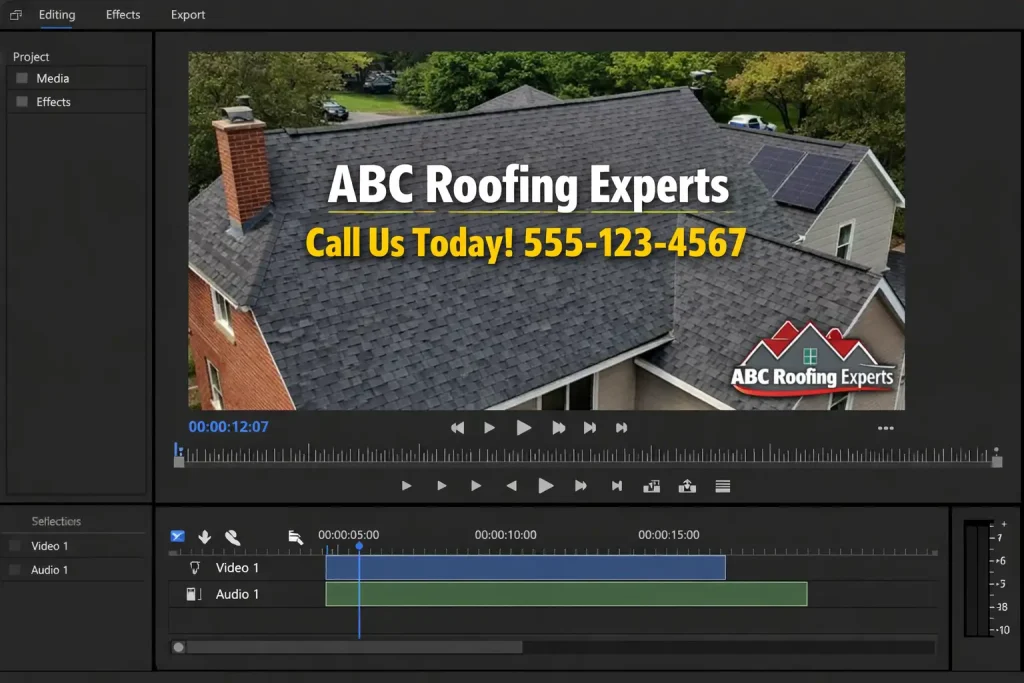
2. Add Text Overlays for Key Information
This is critical for local roofing marketing. Many people watch videos without sound.
Always include:
- Company name
- Phone number
- Website
- Service areas
- Key message (e.g., “Free Roof Inspection”)
Examples of useful overlays:
“Serving Dallas & Surrounding Areas”
“Storm Damage Experts”
“Architectural Shingle Installation” This reinforces your message visually.
3. Incorporate Background Music (Light and Professional)
Music should:
- Be subtle
- Not overpower your voice
- Feel professional
Avoid:
- Loud hype music
- Distracting beats
Look for royalty-free music libraries inside:
- CapCut
- InShot
- YouTube Audio Library
Music enhances emotional tone but clarity always comes first.
4. Add Voiceovers for Clarity
Sometimes job-site audio isn’t ideal due to:
- Wind
- Traffic
- Equipment noise
Record a voiceover afterward in a quiet environment.
Most editing apps allow direct voice recording.
This helps when explaining:
- Installation steps
- Damage findings
- Material comparisons
Clear narration = stronger authority.
5. Basic Color Correction for a Polished Look
Roofing footage is often filmed outdoors. Lighting conditions vary. Use basic tools to:
- Slightly increase brightness
- Adjust contrast
- Improve sharpness
- Warm up overly blue tones
You don’t need cinematic grading.
Just aim for:
- Natural colors
- Clear shingle detail
- Visible roof texture
Better visuals = better perceived quality.
Optimizing Your Roofing Videos for Search Engines
Video SEO helps your content rank on:
- YouTube (second-largest search engine)
- Local search results
- Google Business Profile listings
And for roofers, local relevance is everything.
1. Keyword Research for Roofing Videos
Before uploading any video, ask: What would a homeowner type into Google if they needed this service?
Step 1: Identify Service + Location Keywords
Examples:
- “roof repair Dallas”
- “roof replacement Fort Worth”
- “hail damage roof inspection Plano”
- “metal roofing contractor Tarrant County”
Always combine:
Service + Location
That’s how local leads find you.
Step 2: Use Simple Keyword Tools
You don’t need expensive software to start.
Use:
- Google Keyword Planner
- YouTube search bar (autocomplete suggestions)
- Google search suggestions
- “People also ask” sections
If YouTube suggests:
“how to spot hail damage on roof” That means people are searching for it.
Now localize it:
“How to Spot Hail Damage on Your Roof in [City]”
That’s strategic positioning.
2. Crafting SEO-Friendly Video Titles
Your title has two jobs:
- Rank
- Get clicked
Formula for Roofing Video Titles:
Primary Keyword + Location + Benefit
Examples:
- “Roof Repair in Austin: 5 Signs You Need Immediate Service”
- “Hail Damage Roof Inspection in Denver – What Homeowners Must Know”
- “Roof Replacement Cost in Tampa (2026 Guide)”
Expert Tip: Always Optimize for Local SEO
Include your:
- City
- County
- Region
- Service area
Not just in the title but also in:
- Description
- Tags
- Spoken content (say your city in the video)
Search engines pick up geographic signals.
That improves local rankings significantly.
3. Writing Detailed Video Descriptions
Your description is not optional.
It strengthens SEO and drives conversions.
What to Include in Every Roofing Video Description:
- A Keyword-Rich Opening Paragraph
Example:
“If you’re looking for roof repair in Houston after a recent storm, this video explains how to identify hail damage and what steps to take next.”
- Service Areas
“Serving Houston, Katy, Sugar Land, and surrounding areas.”
- Call-to-Action
“Call us today for a free roof inspection: (123) 456-7890”
- Website Link
Include direct links to:
- Service pages
- Contact page
- Storm damage page
- Timestamps (For Longer Videos)
Example:
00:00 – Introduction
01:15 – Signs of hail damage
03:20 – Inspection process
05:45 – What to do next
Timestamps improve user experience and SEO performance.
4. Utilizing Relevant Tags
Tags help search engines understand context.
Include:
- roof repair [city]
- roofing contractor [city]
- hail damage repair
- roof inspection
- roof replacement cost
You can also add:
- Related roofing terms
- Local city variations
- Competitor names (use carefully and ethically)
Tags are supportive titles and descriptions matter more.
5. Creating Compelling Thumbnails
Your thumbnail determines whether someone clicks.
Even if you rank first, a weak thumbnail loses traffic.
Why Thumbnails Matter
They:
- Increase click-through rate (CTR)
- Improve algorithm performance
- Make your brand recognizable
What Makes a Strong Roofing Thumbnail?
- Clear image of a roof (before/after works well)
- Large readable text (3–5 words max)
- High contrast colors
- Your logo in the corner
- Consistent branding style
Example thumbnail text:
“HAIL DAMAGE?”
“ROOF COST GUIDE”
“DON’T IGNORE THIS”
Keep it simple and bold.
You can design thumbnails easily using:
- Canva
Create a reusable template so every video looks cohesive.
6. Transcripts & Closed Captions
This is a hidden SEO advantage.
Search engines read text better than they understand video.
Adding captions:
- Improves accessibility
- Increases watch time
- Helps rank for more keywords
How to Add Them
On YouTube:
- Upload your video
- Use auto-generated captions
- Edit for accuracy
For higher accuracy:
- Upload your own transcript file
Bonus tip:
Repurpose transcripts into blog posts.
Now one video becomes:
- YouTube content
- Website blog
- Social media captions
Measuring What Matters: Tracking ROI & Refining Your Video Strategy
You’ve filmed, optimized, and distributed your roofing videos.
Now comes the part that separates hobby marketing from a revenue-generating system: measuring ROI. Without tracking, you won’t know what’s working or what’s wasting time. For busy roofing business owners, understanding ROI ensures every minute and dollar counts.
Key Metrics to Track
Measuring video success isn’t just vanity numbers like views. Focus on actionable metrics that tie directly to business growth.
1. Reach & Awareness
These metrics show how many people saw your video:
- Views – total number of times your video was watched
- Impressions – how often your thumbnail was shown
- Unique viewers – how many individual users watched
Why it matters:
If your videos aren’t being seen, they can’t generate leads. Low reach may indicate poor SEO, thumbnail, or title optimization.
2. Engagement
Engagement measures how well your content resonates with viewers:
- Watch time / average view duration – are viewers watching until the end?
- Likes, comments, shares – audience interaction and social proof
Expert Tip: Analyze these metrics regularly. High watch time indicates the content is valuable and keeps potential clients’ attention. Low engagement may mean your video is too long, unclear, or off-topic.
3. Website Traffic
If you embed videos on your service pages or include links in descriptions:
- Track clicks from video to your website
- Monitor which videos drive the most traffic to key landing pages
Why it matters:
Traffic from video is warm these viewers already trust your brand.
4. Lead Generation
The most important metric: are your videos generating inquiries?
Track:
- Form submissions from video-specific landing pages
- Phone calls using unique video numbers
- Direct messages referencing the video
Tip: Ask prospects, “How did you hear about us?” during initial contact.
5. Conversions
This is the ultimate measure: did your videos turn views into revenue?
- Closed jobs attributed to video leads
- Average revenue per video lead
- ROI calculation:
ROI=Revenue from video leads – Video costsVideo costs×100ROI = \frac{\text{Revenue from video leads – Video costs}}{\text{Video costs}} \times 100ROI=Video costsRevenue from video leads – Video costs×100
This gives realistic insight into the business value of your video marketing.
Tools for Analytics
Use the right tools to simplify tracking:
- YouTube Studio – YouTube performance metrics (views, watch time, CTR)
- Google Analytics – Track traffic from embedded videos to your website
- Social media insights – Facebook, Instagram, TikTok, LinkedIn
- CRM systems – Track video leads and follow-ups
Attributing Leads & Sales to Video Efforts
To accurately measure ROI:
- Create unique landing pages for each video campaign
- Use trackable phone numbers
- Ask prospects “Where did you hear about us?”
This ensures every lead has a clear source.
Refining Your Strategy Based on Data
Tracking metrics is only half the job. Use insights to improve future performance:
- Identify high-performing content types:g., Before & After videos vs. FAQs
- Adjust distribution channels: which platforms generate the most leads?
- Optimize video length: shorter videos for social media, longer for YouTube
- Improve call-to-actions: experiment with phrasing and placement
Expert Tip: Create a Monthly Video Review
Even 20–30 minutes per month reviewing performance can:
- Pinpoint your best ROI content
- Show where effort is wasted
- Inform your next video topics and promotion strategy
It’s a small investment for a huge payoff.
Overcoming Hurdles: Common Challenges & Actionable Solutions
Even the best strategies face roadblocks. Roofing contractors often hesitate to start video marketing because it feels overwhelming, expensive, or technically intimidating. Let’s tackle these hurdles head-on with practical, no-fluff solutions.
Challenge: “I don’t know where to start or what to create.”
Solution:
Start simple. Use the Video Content Idea Brainstorming Table or the Video Idea Generator Quiz. Begin with:
- FAQs from clients
- Before & After project clips
- Quick maintenance tips
Small, focused content builds confidence and momentum.
Challenge: “I lack budget for professional equipment or agencies.”
Solution:
Embrace a DIY approach:
- Smartphone camera
- Basic lighting (even natural sunlight works)
- External microphone for clear audio
Focus on authenticity over high production value. Tools like:
- CapCut
- InShot
- DaVinci Resolve (Free version)
…make editing professional-looking without a huge budget.
Challenge: “My videos won’t look professional without technical skills.”
Solution:
Prioritize fundamentals:
- Clear audio
- Stable footage (tripod or handheld stabilizer)
- Concise messaging
- Basic editing with text overlays, intro/outro branding
Consistency beats perfection. Even simple, repeatable videos outperform “perfect” sporadic uploads.
Challenge: “Fear of being on camera or feeling awkward.”
Solution:
Start small:
- Use voiceovers instead of showing yourself
- Feature team members or project-focused shots
- Record multiple takes and edit down
Expert Tip: Authenticity resonates more than polished perfection. Your local audience values real people and genuine explanations.
Challenge: “Difficulty generating consistent content ideas.”
Solution:
Leverage daily roofing activities:
- Common client questions
- Recent projects
- Material explanations
- Seasonal maintenance tips
Repurpose existing content like blog posts, FAQs, or social updates into video format.
Challenge: “Struggling to distribute videos effectively.”
Solution:
- Focus on local SEO optimization
- Upload to Google Business Profile
- Use targeted social media ads
- Embed videos on your website and local landing pages
Challenge: “Uncertainty about measuring ROI.”
Solution:
- Track metrics from day one
- Use unique landing pages and phone numbers
- Ask every client: “How did you hear about us?”
This links video efforts directly to business results.
Challenge: “Time constraints for planning, shooting, editing, and promoting.”
Solution:
- Batch content creation (film multiple videos in one session)
- Create simple scripts/outlines
- Use quick editing apps for mobile
- Repurpose content across multiple platforms
- Delegate tasks if possible (team member or assistant)
Key Action Steps for Roofing Video Marketing
Key Action Step | Purpose / Benefit |
Define Target Audience & Goals | Ensures videos resonate and align with business objectives |
Brainstorm Video Ideas (using table/quiz) | Generates relevant, engaging content concepts |
Create Simple Scripts/Outlines | Provides clear direction, saves time, ensures key messages |
Gather Basic Equipment (smartphone, mic, tripod) | Enables high-quality DIY production on a budget |
Record Stable, Clear Footage (good audio/lighting) | Foundation for professional-looking, engaging videos |
Edit Videos (trim, add text, music, branding) | Polishes content, enhances brand identity, improves viewer experience |
Optimize for Video SEO (title, description, tags, thumbnail) | Maximizes visibility on YouTube and Google search |
Distribute Across Key Platforms (YouTube, GBP, Social) | Reaches maximum local audience and builds online presence |
Promote Videos (website embed, email, local groups) | Drives traffic, engagement, and lead generation |
Track Key Metrics & Analyze Performance | Measures ROI, informs future strategy, ensures continuous improvement |
Implement Strong Call-to-Actions | Guides viewers to next steps, converts interest into leads |
Prioritize Authenticity & Consistency | Builds trust, fosters engagement, keeps your brand top-of-mind |
Expert Tip: Start Now, Improve Over Time
Many roofers wait for “perfect conditions” to start.
The truth: progress beats perfection.
Even a simple, authentic video uploaded consistently will generate leads, build trust, and improve your local reputation far faster than waiting to create the “perfect” production.
Conclusion: Your Path to Video Marketing Success in the Roofing Industry
Video marketing is no longer optional it’s a game-changer for local roofing businesses. Even on a modest budget, you can create compelling videos that build trust, showcase expertise, and connect with your community.
Reinforce Key Takeaways
- Video marketing helps roofers stand out in a crowded local market.
- It humanizes your brand and demonstrates your craftsmanship.
- You don’t need professional studios smartphones, basic equipment, and authentic messaging are enough to start generating results.
Long-Term Benefits
A consistent, strategic video approach can deliver:
- Increased brand visibility across Google, YouTube, and social platforms
- Stronger local reputation as a trusted roofing expert
- A steady stream of qualified leads from homeowners, property managers, and commercial clients
- Sustainable business growth and predictable ROI
Frequently Asked Questions (FAQs)
How does AI video marketing help generate high-ticket clients?
AI-powered video marketing uses data-driven insights, proven hooks, and conversion psychology to create videos that attract qualified prospects. Instead of just views, the focus is on generating booked appointments and serious inquiries from decision-makers.
What makes your video marketing different from traditional agencies?
Unlike traditional agencies that focus only on production quality, we focus on conversion-driven video systems. Our strategy combines AI research, audience targeting, scripting, editing, and funnel alignment to turn attention into appointments — not just impressions.
Who is your video marketing service best suited for?
Our services are ideal for:
B2B companies
Coaches and consultants
Agencies
High-ticket service providers
Personal brands looking to scale
If your business depends on booked calls and qualified leads, our approach is designed for you.
Do I need professional equipment to get started?
No. You don’t need expensive equipment. We guide you on using simple tools like smartphones and basic lighting if needed. The focus is on messaging and conversion — not Hollywood-level production.
How long does it take to see results?
Results vary depending on niche, offer, and distribution strategy. However, many clients begin seeing improved engagement and qualified inquiries within the first few weeks of consistent video deployment.
Do you handle the entire video process?
Yes. We manage strategy, scripting, editing, optimization, and distribution guidance. Our goal is to create a streamlined system that consistently produces high-performing video assets.
What platforms do your video strategies work best on?
Our video systems are optimized for:
YouTube
Instagram Reels
TikTok
Facebook Ads
LinkedIn (for B2B targeting)
We tailor strategy based on where your ideal clients spend time.
How do you track ROI from video marketing?
We track performance using:
Click-through rates
Watch time
Lead submissions
Booked calls
Cost per acquisition
Our focus is always on measurable growth, not vanity metrics.